Re-peel
Everyone swears by Peel’s principles. But Peel didn’t write them, and almost nobody has read them.
I studied philosophy at university, then spent eight years in policing, six of them at the Met. My degree never mentioned the police. The job raised ethical questions every day. This is my attempt to join the two up. I will survey the ideas and see what falls out, and I promise to settle nothing.
The Question
Is policing a nasty necessity, or something good?
Most people don’t ask - they’ve absorbed an idea and run with it. The Stanford Encyclopedia of Philosophy has entries on punishment, desert, coercion and civil disobedience. It has no entry on the ethics of policing.
I have seen first hand that police do good, and I’m tired of the pretence that they don’t. An ambulance service manager once told me that London’s police save more lives than they do. I can’t prove that, of course, but sheer logistics makes it plausible. On any given night there are far more police cars out than ambulances. Since 2017, over 700 Met response vehicles and stations have carried defibrillators, with every officer trained to respond to cardiac arrests and provide first aid. All those golden minutes add up.
Principles
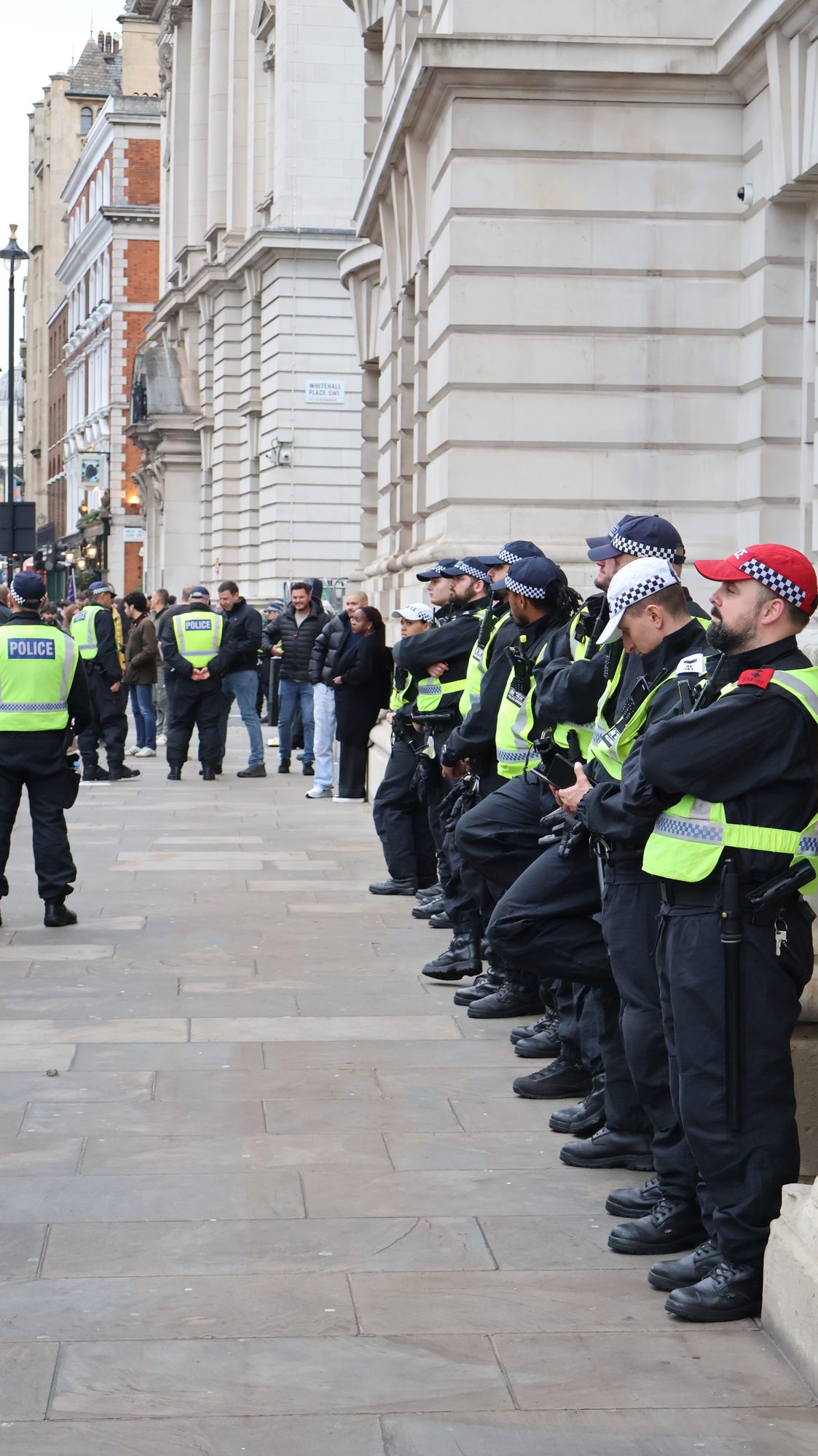
The British police have a holy book: the nine Peelian principles. They are named after Sir Robert Peel, who founded the Met in 1829. They are quoted in inspection reports, parliamentary debates and every conversation about “policing by consent”. The government publishes them in full.
The awkward part is that the same government page admits “there is no evidence of any link to Robert Peel”. The 1829 instructions were probably written by the first two commissioners, Charles Rowan and Richard Mayne. The numbered list of nine was assembled by a historian, Charles Reith, in the mid-twentieth century. A 2025 paper in Policing and Society calls the principles “a fabrication of more recent times”. The founding document is a summary, written 120 years late, of what someone thought the founders meant. Very few people have noticed.
Does it matter? For the content, no. The ideas stand or fall on their own. It matters as evidence of something else: nobody ever examined them. The principles achieved scripture without a single round of scrutiny.
-
To prevent crime and disorder, as an alternative to their repression by military force and severity of legal punishment.
-
To recognise always that the power of the police to fulfil their functions and duties is dependent on public approval of their existence, actions and behaviour, and on their ability to secure and maintain public respect.
-
To recognise always that to secure and maintain the respect and approval of the public means also the securing of the willing co-operation of the public in the task of securing observance of laws.
-
To recognise always that the extent to which the co-operation of the public can be secured diminishes proportionately the necessity of the use of physical force and compulsion for achieving police objectives.
-
To seek and preserve public favour, not by pandering to public opinion, but by constantly demonstrating absolutely impartial service to law … by ready offering of individual service and friendship to all members of the public without regard to their wealth or social standing … and by ready offering of individual sacrifice in protecting and preserving life.
-
To use physical force only when the exercise of persuasion, advice and warning is found to be insufficient to obtain public co-operation to an extent necessary to secure observance of law or to restore order, and to use only the minimum degree of physical force which is necessary on any particular occasion for achieving a police objective.
-
To maintain at all times a relationship with the public that gives reality to the historic tradition that the police are the public and that the public are the police, the police being only members of the public who are paid to give full-time attention to duties which are incumbent on every citizen in the interests of community welfare and existence.
-
To recognise always the need for strict adherence to police-executive functions, and to refrain from even seeming to usurp the powers of the judiciary of avenging individuals or the State, and of authoritatively judging guilt and punishing the guilty.
-
To recognise always that the test of police efficiency is the absence of crime and disorder, and not the visible evidence of police action in dealing with them
A question to start: should they be ranked, the way human rights are ranked? Should Principle 9 - “the test of police efficiency is the absence of crime and disorder” take precedence over the others? I don’t know. Has anyone thought about it?
Without Fear or Favour
Note, also, that ‘Without Fear or Favour’ has never featured in the prescribed Police attestation. It’s for the magistrates’. Although it was a similar ‘without favour or affection, malice, or ill-will’ before 2002.
Some will swear blind that it was, or even that it is! So what does it say about the Police as a people, and their ethics, that they so badly want it to be true? And what does it say about the public that people so readily reach for it. Fairness, it seems, is key. But what does that mean?
One thing that is sure: no matter how many corporate codes of ethics are issued, this is the one ethical text that every constable personally, publicly, and officially affirms. So why is it almost never mentioned post ceremony?
Attestations
In case you’re interested.
Metropolitan Police Act 1829 — no oath wording in the Act.
1831 / 1835 / 1839 Acts (Special Constables, Municipal Corporations, County Police) — required constables to be sworn; no prescribed wording.
Police Act 1964, s.18 + Sch. 2 — the first confirmed form: “I … do solemnly and sincerely declare and affirm that I will well and truly serve Our Sovereign Lady the Queen in the office of constable, without favour or affection, malice or ill will; and that I will to the best of my power cause the peace to be kept and preserved, and prevent all offences against the persons and properties of Her Majesty’s subjects; and that while I continue to hold the said office I will to the best of my skill and knowledge discharge all the duties thereof faithfully according to law.”
Police Act 1996, s.29 + Sch. 4 — restates the 1964 form unchanged.
Police Reform Act 2002, s.83 — “…well and truly serve the Queen in the office of constable, with fairness, integrity, diligence and impartiality, upholding fundamental human rights and according equal respect to all people; and that I will, to the best of my power, cause the peace to be kept and preserved and prevent all offences against people and property…”
Whither Policing?
Ethics can be about consequences: what would happen without police? History has run the experiment a few times, sort of:
-
Montreal, 7 October 1969. The city’s police went on strike for sixteen hours. Widespread looting, a gun battle at a limousine garage, a provincial police corporal shot dead, 108 arrests, and the army on the streets by midnight. (The city was already primed - terrorist bombings, a taxi war - so not exactly a controlled pseudo-experiment.)
-
Copenhagen, September 1944. The Nazis arrested the Danish police. A famous account says burglary rose tenfold; the Danish consul general disputed that, blaming organised collaborator gangs for much of the spike. The sober academic reading: street crimes that depend on visible patrol rose sharply.
-
New York, winter 2014-15. The NYPD staged a seven-week slowdown, roughly halving summonses and stop-and-frisks. People stopped calling - major crime complaints fell by about 5.5%.
The researchers’ explanation is that aggressive low-level enforcement erodes trust and breeds crime of its own. I think the citizenry were just listening to the same news and knew there was no point calling. I think this because that’s what’s happening in London right now as I type this. People don’t even bother calling.
The deterrence literature is more settled than the folk version of it. “The certainty of being caught is a vastly more powerful deterrent than the punishment”, per the US National Institute of Justice. Visible patrol of crime hot spots works: a meta-analysis of 65 studies found modest but real reductions, and one UK trial returned £5.60 to £23 for every £1 spent. Harsh sentences deter almost nobody; a constable on the corner deters plenty.
And yet criminologists still cannot agree on what caused the great American crime decline of the 1990s. More police, new tactics, harsher sentences, demographics: the statistics cannot separate the candidates. After fifty years of quantitative criminology the counterfactual question stays open.
Some Philosophy
So outcomes alone will not settle it. Time to raid the philosophy shelf.
Bentham argued that all punishment “in itself is evil”, and is only admissible when it excludes some greater evil. Policing on this view is a cost we pay to avoid a larger cost. The classic objection: if punishing an innocent man reduced crime, this logic would allow it. The philosopher E. F. Carritt made the point with a hanged innocent whose guilt everyone believes. Convenient, but wrong.
Just deserts runs on a different engine. Punishment is justified because wrongdoers deserve it, and desert is “logically prior to and independent of public institutions”. Where do police fit? Hobbes and Locke supply the answer: in the state of nature, victims punish their own wrongdoers, badly. The state’s monopoly on force is that private right, pooled and handed to professionals. A constable is your delegated vengeance, with the anger filtered out. (This is also the argument against vigilantes.)
Kant goes further, and this is the strongest positive case. Coercion, he argues, “is part of the idea of rights” itself. A right that cannot be enforced is a wish. Law’s coercive force is what secures freedom, on this account, rather than limiting it. Police stop being a regrettable add-on to law and become part of what law is. Law without police is pointless, or worse.
Virtue ethics changes the subject from rules to character. Aristotle’s word is phronesis - practical wisdom, the judgement that applies principles to particulars. No rulebook applies itself. Every officer on every shift exercises discretion the law cannot specify in advance. That is phronesis, exercised at 3am beside a broken shop window. Good policing, on this view, is a character trait before it is a procedure.
Then there is the Buddhist cop. Cheri Maples was a Wisconsin police captain ordained as a dharma teacher by Thich Nhat Hanh. She asked him whether a Buddhist could carry a gun. His answer: “Who else would we want to carry a gun besides somebody who will do it mindfully?” The classical Buddhist texts point the same way. A ruler must sometimes use force, and should punish out of compassion, “especially compassion for the criminals themselves”. Never anger or vengeance.
The theological version is older still. Paul’s letter to the Romans calls the magistrate “the minister of God to thee for good”, who “beareth not the sword in vain”. Enforcers as ministers. I’m not the target audience for this one, but I do notice the family resemblance across every tradition here: force is acceptable only in the hands of someone answerable to something - an idea, institution, or being - higher than themselves.
The Codes
The modern fix for all this is the corporate code of ethics. Policing got (another) a new one in 2024. To the officers reading: can you list them right now, off the top of your head? They are abstractions and some supporting guidance. They hardly rouse the spirit. Useful for disciplinary panels, but for the real, ethical discipline that governs day-to-day life? Not really.
Codes like this fail for the reason the virtue ethicists identified: rules do not apply themselves. A principle that nobody weighs at the moment of decision is a poster in a corridor. The 1829 General Instructions at least told a constable how to behave on the street, and the culture of the time enforced them. A laminated value has no such teeth. Officers know this, which is why the codes are received with a shrug. The shrug is the correct philosophical response.
What Next
It seems clear, to me, that this body of policy requires a lot more thought than it has received thus far. I compare it to the tranches of philosophy I had to read for my Public Policy and even economics courses, and it comes up totally empty.
I think Policing is an essential component of democracy that has never done its homework, assuming its existence being above (or beneath) even minimal justification.
But policing by consent needs the police to say less like ‘Well if you don’t like us, don’t call us!’, if it deigns to answer at all.
It needs to say more ‘We’re good, actually. You should Trust us. And here’s why.’