Logic 101: lesson 1

Join me as I recap my logic notes from university, all the way from the bottom. Lesson one.
Rhetoric
Einstein persuaded physicists with arguments and evidence. Hitler persuaded a nation with the power of his words alone. An argument gives reasons. Rhetoric persuades without them - through fear, pride or flattery.
It can look like an argument, but its pull comes from the emotion in the words:
“Only one in the grip of madness could fail to see the need for…”
Arguments
In logic, an “argument” means a set of premises (reasons) and a conclusion (the claim they support), not the row you might think.
“All whales are mammals. Tony Blair is a mammal. So Tony Blair is a whale.” That is a (bad) argument.
Propositions
“David Beckham has signed for LA Galaxy” and “LA Galaxy have signed David Beckham” are two sentences with one meaning. That meaning is a proposition: what a sentence says when it states something true or false.
Questions and commands have none, because they don’t state anything. Logic works on propositions, so rewording the sentence doesn’t change the argument.
Standard Form
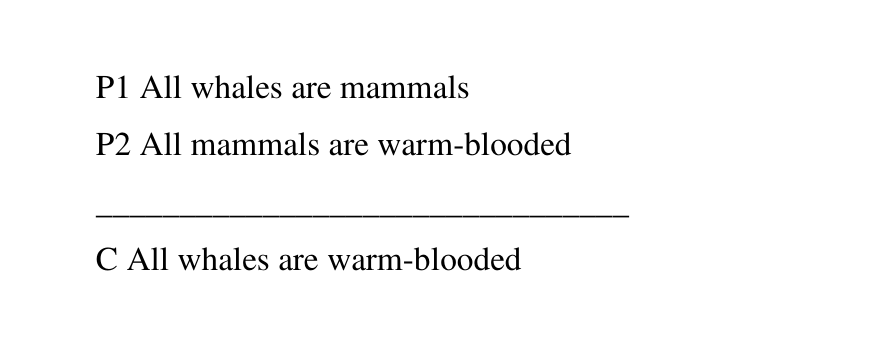
Number the premises P1, P2. Draw a line - the inference bar, read as “therefore”. Write the conclusion as C.
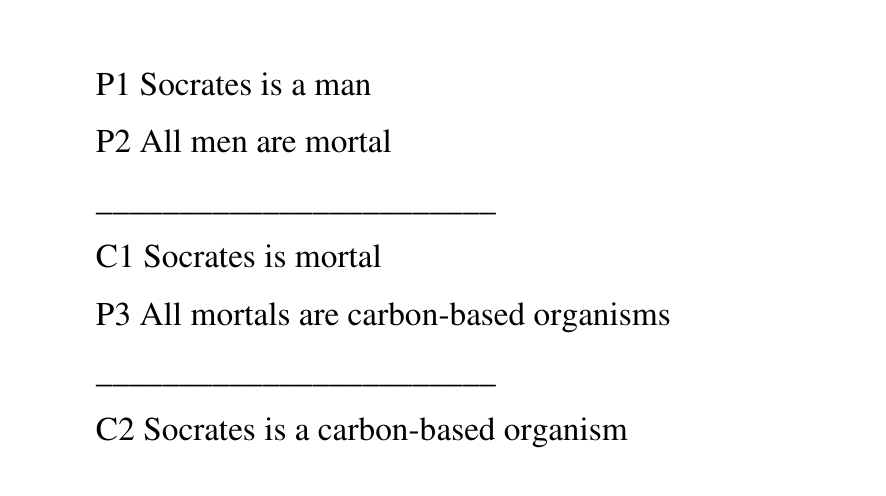
Arguments can chain, with one conclusion becoming a premise for the next step:
Signpost Words
Conclusion words: so, hence, thus, therefore, it follows that. Premise words: because, since, the reason is, my evidence for this is.
“Because” can also give a cause. “The plutonium exploded because it reached critical mass” explains the explosion. Nobody is arguing it happened.
Ambiguity
Lexical ambiguity: one word, two meanings. “He is sitting by the bank.” Which bank?
Syntactic ambiguity: one sentence, two structures. “Police are searching for a man in a white van.” Who is in the van?
What Next
Lesson two: deduction and validity. Whether a conclusion follows from its premises is a separate question from whether those premises are true.