The Pen and the Keyboard
The Problem
I use AI for most of the working day, and I have noticed how it diminishes me. Work gets done faster than ever, yet I recall less of it than ever. I’ll read a document and then a week later, they might as well have been someone else’s work. Psychologists saw this coming before current AI tools existed. Sparrow’s 2011 “Google effect” study found people remember where information is located, not the information itself. An assistant that does writing as well as finding pushes this further. Memory is made by doing, but now I’m coordinating more than anything else.
The Idea
Handwriting makes you slow down and think. It forces you to choose words before committing them, and choosing and producing are what fix a thing in memory. Mueller and Oppenheimer showed this with students in 2014. Laptop note-takers transcribed lectures nearly verbatim and remembered less. The ones writing by hand had to compress ideas to keep up, and they retained more.
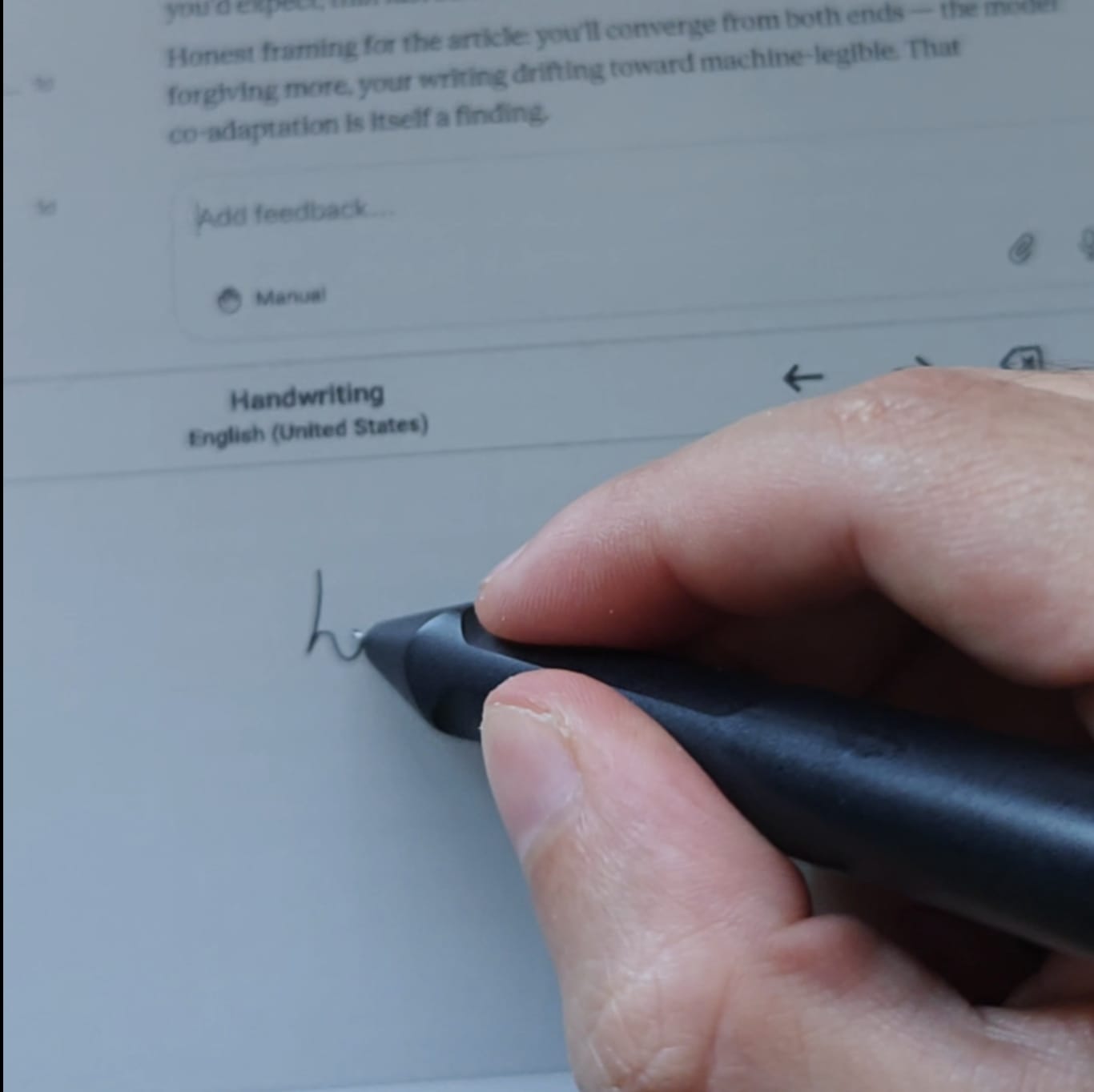
So the experiment: put a pen between me and the AI. I write prompts and notes by hand on an e-ink tablet. The stack behind handles what I shouldn’t have to think about - syncing pages home, reading my handwriting, carrying answers back. I still get the model’s speed for the big tasks. What I add back is the slow, deliberate front end. Could the pen finally be as powerful as the sword keyboard?
The Build
A Supernote Manta is an e-ink writing tablet with no browser and no notifications. It syncs its pages to a self-hosted private cloud on a retired laptop in my homelab, so nothing touches a third-party service. The Claude app is sideloaded onto the tablet. From my sofa I can drive the AI tooling on my desktop, handwriting into a chat box, and it can then do everything else. Handwritten pages or sketches, where applicable, convert to text on the way through, so a note scrawled in bed can end up as instructions to an agent very easily.
First Impressions
Recognition is the weak point. My first handwritten prompt arrived as “5 am now interacting with hand writing” - the 5 was meant to be an I. It’s not the end of the world because the prompts don’t auto-send, but it’s tedious to correct them constantly. My handwriting is bad, and the system currently punishes that. Whether the fix is better models or better penmanship is an open question; I suspect we will meet in the middle.
The pace change is real, though. A prompt that costs a minute of careful writing gets thought about before it is sent. I write shorter, ask for less, and read what comes back properly because the next question costs another minute. On a keyboard, I fire off half-formed requests and skim answers. The pen has already rate-limited me into better habits, one day in.
What Next
This blog was fully typed. I suspect it will remain the case that I am at the computer for some of what I do. But let’s see!
A month of use? Then we’ll see: either the tablet becomes the way I talk to the machine or it is in a drawer. Will blog it. The longer plan is to point the tablet at my local models instead of the cloud. Then the whole loop - handwriting, conversion, answer - runs on hardware I own.
Thanks for reading!